
BISBEE MINERALS
Learn About Bisbee Minerals on Thrilling Jeep Tours
Bisbee, Arizona, is a treasure trove of geological wonders, renowned for its rich mineral deposits that have shaped its history and contributed to its reputation as a mining hotspot. This small town, nestled in the Mule Mountains, has yielded an astonishing variety of minerals, each telling its own story of Earth's vibrant and dynamic interior. From vivid azurite to gleaming malachite, the list of minerals found in Bisbee is extensive and impressive, showcasing a palette of colors and forms that attract collectors, geologists, and history enthusiasts alike. Here, we explore some of the most remarkable minerals that have been unearthed in Bisbee, offering a glimpse into the subterranean beauty that lies beneath its rugged landscape.

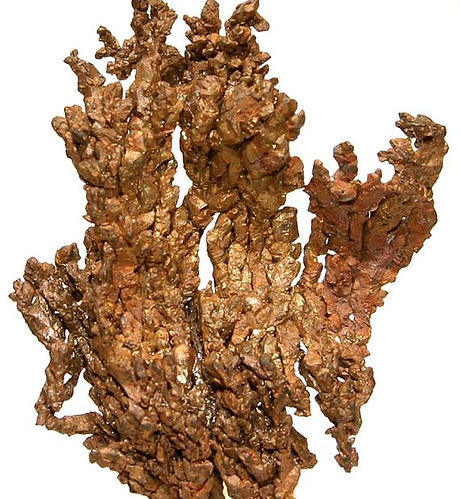
COPPER
Copper, scientifically known as Cuprum with the chemical symbol Cu, is a reddish-orange metal that is highly regarded for its ductility and conductivity. It possesses a distinctive metallic luster and can develop a green patina when exposed to the elements over time. This greenish layer, often seen on historical buildings and statues, is due to the formation of copper carbonate. Copper is commonly known by other names, such as "red metal" due to its distinctive hue and "native copper" when it is found in its natural, unalloyed form. Its ability to conduct electricity and heat efficiently makes it invaluable in electrical wiring, plumbing, and numerous industrial applications.
Copper holds significant importance to Bisbee, Arizona, which has a rich history as one of the premier copper mining towns in the United States. The extraction of copper ore from the region fueled Bisbee's growth and economic prosperity in the late 19th and early 20th centuries. A unique quality of copper is its antibacterial properties, which have been utilized throughout history to maintain hygiene and combat infection. In Bisbee, copper mining played a crucial role in shaping the town's identity, contributing to its architectural heritage and cultural development, making it a focal point for both historical exploration and tourism in Bisbee. The town's mines, particularly the renowned Copper Queen Mine, attracted workers from around the world, leaving a lasting impact on the community's diverse cultural landscape.
Gold
Gold, scientifically known as Aurum (Au), is a precious metal with a lustrous yellow appearance that has captivated human societies for centuries. It is one of the densest elements, possessing remarkable malleability and ductility, which allows it to be hammered into thin sheets or drawn into fine wires. Known for its brilliance and resistance to tarnish, gold is often associated with wealth and luxury. Other popular names for gold include "the yellow metal" and "the metal of kings." Its rarity and beauty make it a symbol of prestige and power.
One unique quality of gold is its exceptional conductivity, which makes it invaluable in electronics and various industrial applications. In Bisbee, Arizona, gold played a significant role in the town's mining history. While Bisbee is more famous for its copper mining, gold was also extracted in the area, contributing to its economic development during the mining boom. The allure of gold and other minerals attracted settlers and investors, helping to establish Bisbee as a vibrant mining community. Today, the legacy of gold mining is part of Bisbee's rich history, drawing tourists and history enthusiasts to explore its past.

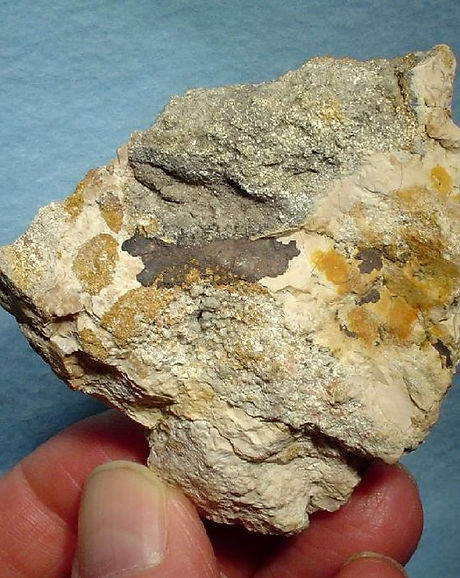
Silver
Silver, scientifically known as argentum (Ag), is a lustrous, white, metallic element highly valued for its brilliant shine and reflective properties. As a transition metal, silver boasts a characteristic gleaming appearance that has captivated humans for centuries. Commonly referred to by names such as "sterling" when alloyed with copper for use in jewelry and silverware, silver is renowned for its excellent electrical conductivity, which makes it an essential component in the electronics industry, from circuit boards to solar panels.
In Bisbee, Arizona, silver holds historical significance as a valuable byproduct of copper mining, which was the primary economic driver in the region during the late 19th and early 20th centuries. The extraction of copper led to the incidental discovery of silver deposits, contributing to Bisbee's economic development and growth. This made Bisbee a thriving mining town and cultural hub, attracting miners and settlers. The legacy of silver and copper mining is still visible in the town's rich history and preserved architecture, which continue to draw tourists and history enthusiasts to Bisbee today.
Bisbee Blue Turquoise
Bisbee Blue Turquoise, scientifically known as "Cyanus bisbeeanus," is a highly prized gemstone characterized by its vibrant blue color with a unique matrix of chocolate-brown or reddish-brown webbing. This striking appearance is a result of the high copper content in the region where it is found. The gemstone is often called "Bisbee Blue" due to its vivid hue and is sometimes referred to as "Bisbee Turquoise" or simply "Bisbee." The stone's vibrant blue color is unmatched, setting it apart from other types of turquoise, making it a sought-after choice for high-end jewelry.
One unique quality of Bisbee Blue Turquoise is its rarity, as it is no longer actively mined, making existing pieces highly valuable and coveted by collectors and jewelers alike. This rarity has solidified its status as a collector's item, further enhancing its desirability. Bisbee Blue Turquoise holds significant historical and cultural importance to Bisbee, AZ, as it was originally discovered in the copper mines of the area. This gemstone is a testament to Bisbee’s rich mining heritage, serving as a lasting symbol of the town’s connection to the mining industry and its influence on the local economy and culture.

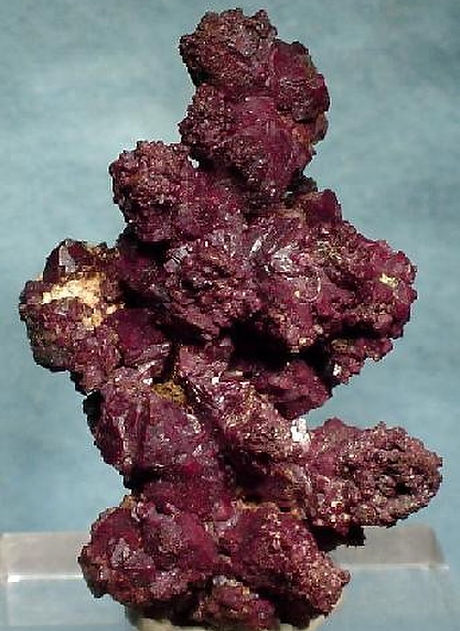
Cuprite
Cuprite, scientifically known as Cu₂O, is a copper oxide mineral renowned for its vibrant and captivating appearance. It typically manifests in rich red to reddish-brown hues, with a striking adamantine to submetallic luster. Often found in octahedral crystal forms, cuprite can also occur as earthy or granular masses. This mineral's translucent to opaque crystals can appear almost metallic due to their high refractive index, making them particularly attractive to mineral collectors. Known by other popular names such as ruby copper and red copper ore, cuprite's unique coloration and crystal structure make it a standout among copper minerals.
One of cuprite's unique qualities is its high copper content, which can reach nearly 88% by weight. This high concentration of copper makes cuprite an important ore for copper extraction, particularly in regions rich in copper mining history. In Bisbee, Arizona, cuprite has played a significant role in the area's mining heritage. Bisbee, known for its extensive copper mines, has long been a source of this valuable mineral. Cuprite's presence in the Bisbee mines not only highlights the town's rich mineral diversity but also underscores its historical importance in the copper mining industry, contributing to Bisbee's development and economic prosperity over the years.
Malachite
Malachite, scientifically known as copper carbonate hydroxide \((\text{Cu}_2\text{CO}_3(\text{OH})_2)\), is a striking green mineral known for its vibrant and varied banding patterns. Its appearance ranges from deep, rich greens to lighter, more translucent hues, often displaying intricate, swirling patterns or concentric circles. This mineral can be found in botryoidal, stalactitic, or crystalline forms, making it highly sought after for decorative and ornamental purposes. Commonly referred to as "peacock stone" or "green copper ore," malachite has been used for centuries in jewelry and as a pigment due to its eye-catching colors and unique patterns.
One unique quality of malachite is its historical use as a pigment in green paints and its ability to react with acids, releasing carbon dioxide gas. In Bisbee, AZ, malachite holds particular significance due to the town's rich mining history. Bisbee was once a thriving copper mining town, and malachite, being a secondary copper mineral, is abundant in the area. The presence of malachite and other copper ores contributed significantly to the economic growth and development of Bisbee, attracting miners and settlers in the late 19th and early 20th centuries. Today, malachite remains an important part of Bisbee's cultural and geological heritage, drawing tourists and mineral enthusiasts to the region.
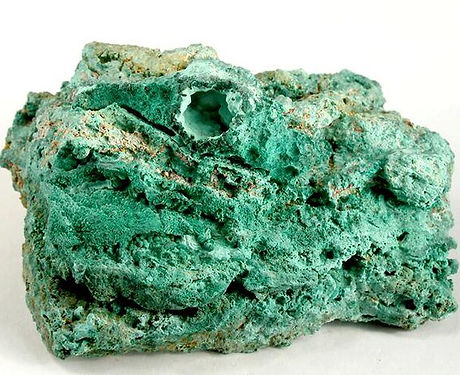

Azurite
Azurite, scientifically known as Cu\(_3\)(CO\(_3\))\(_2\)(OH)\(_2\), is a vibrant blue mineral renowned for its stunning color and intricate crystal formations. It often appears as deep blue prismatic crystals or as massive formations with a vitreous to dull luster. Azurite can also occur in concentric layers or as encrustations on rocks, where its deep blue hue contrasts strikingly with the surrounding materials. This mineral, sometimes called Chessylite, is often associated with malachite, as the two minerals are frequently found together and can sometimes transform from one to the other under specific environmental conditions.
A unique quality of azurite is its ability to be used as a natural pigment due to its intense blue color, which has been valued throughout history for artistic and decorative purposes. In Bisbee, Arizona, azurite holds particular significance because the area is one of the world's renowned locations for high-quality azurite specimens. The mineral is part of the rich mining history of Bisbee, contributing to the town's economic and cultural heritage. Azurite from Bisbee is highly sought after by collectors and geologists, making it an essential aspect of the town's identity and a point of pride for its residents.
Galena
Galena, scientifically known as Lead(II) sulfide, is a naturally occurring mineral known for its metallic luster and lead-gray color. Its cubic crystal form often displays distinct, shiny surfaces that reflect light like polished metal. Sometimes, it can appear in more complex formations, such as octahedral or dodecahedral shapes. Known for its high density and softness, Galena is easily distinguishable from other minerals and can leave a gray streak when rubbed across a porcelain plate. Besides "Galena," it is also commonly referred to as "Lead Glance" due to its lead content and characteristic sheen.
One unique quality of Galena is its status as the primary ore of lead, which historically made it incredibly important for mining operations in the Bisbee, AZ area. The extraction and processing of Galena played a pivotal role in Bisbee's development, contributing significantly to the town's economic growth and reputation as a major mining hub in the late 19th and early 20th centuries. Additionally, Galena often contains silver, making it a valuable resource for silver extraction, further enhancing its importance to the local mining industry. The presence of Galena helped establish Bisbee as a prosperous community, attracting miners and entrepreneurs, and leaving a lasting impact on the town's heritage.

Our Bisbee Tours

2 hours / Mild Travel
Discover Old Bisbee, classic architecture, mining history, the open mines, and Lowell on the private jeep adventure. Our most popular Bisbee tour!
$65 adult / $59 senior

90 minutes / Mild Travel
Enjoy the cultural, mining, and classic architecture in Old Bisbee. Travel narrow, winding two-way streets to panoramic views above the valley.
$50 adult / $45 senior

3 hours / Mild Travel
Learn about Bisbee mining history, the open pits, and Lowell, capped off by a trip to the International border wall in Naco, on this city jeep tour.
$105 adult / $95 senior

4 hours / Mild Travel
See the 12 suburbs of Bisbee that were separate cities. This 30-mile tour starts in Old Bisbee, visits the open mines, Lowell, Naco, Warren, and every suburb in between.
$140 adult / $127 senior

3 hours / Mild Travel
Travel through Old Bisbee's mining and architectural history. See the open mines and Lowell, and then discover Warren and its Cornish roots and famous ballpark.
$105 adult / $95 senior