
A Journey Through Bisbee's History
Tucked into the Mule Mountains of southeastern Arizona, Bisbee grew up fast after rich copper deposits were discovered in 1877. Backed by Phelps Dodge and anchored by the Copper Queen, the “remote” camp became a serious mining district, helped by rail connections and major investment that tied Bisbee’s copper to wider markets. By 1900, the Copper Queen wasn’t alone: companies like Calumet & Arizona and Shattuck & Arizona developed profitable ground, and Bisbee boomed as underground work expanded and mechanization advanced.
Bisbee's History Endured Conflicts
That prosperity came with hard edges - dangerous work, immigration-driven growth, and labor conflict. In 1917, more than 1,100 men were forcibly detained and deported by train (often reported as roughly 1,300), an event that became known as the Bisbee Deportation. The same era witnessed significant changes in how ore was mined: open-pit mining arrived in 1917 with the Sacramento Pit, and later, the Lavender Pit began, extending Bisbee’s mining life by decades. When mining cycles shifted, Old Bisbee didn’t fade into a ghost town; its narrow streets, hillside stairways, preserved buildings, and art galleries helped it reinvent itself into the lively, creative community visitors experience today.

Bisbee Historical Overview: The Mining
Bisbee grew out of the mining boom in the Mule Mountains after mineralization was discovered in Mule Gulch in 1877 - an era when southeastern Arizona was still remote and dangerous, and mine development depended on protection and investment. As rail connections expanded across the region in the late 1880s, base-metal mining (especially copper) became far more economically viable, and Bisbee’s mines scaled up from early high-grade work into an industry that would shape the town for generations.
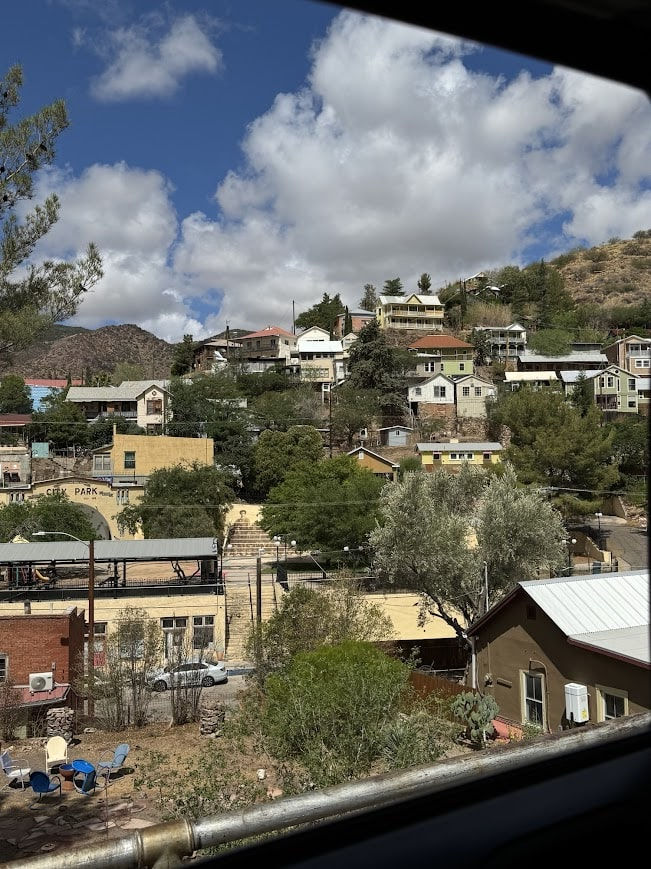
Old Bisbee’s steep, canyon-hugging layout still shows what a boomtown built around mines looks like: hillside homes, tight winding streets, and a mix of miners’ cottages and Victorian-era buildings stacked into the terrain. The mining legacy is inseparable from the town’s identity - especially the long shadow of the Copper Queen Mine and the company history tied to Phelps Dodge’s growing control of operations in the late 1800s and early 1900s.
But prosperity came with real hardship. Mining labor in Bisbee involved bitter disputes and clashing union movements, and in 1917, the conflict escalated into the infamous Bisbee Deportation - when more than 1,100 men were forcibly detained and deported by train, an action widely condemned in retrospect as union busting. Those tensions—along with the risks and struggles of miners’ lives - remain a central part of Bisbee’s story, not just its scenery.
The Rise and Fall of Mining in Bisbee
Mining made Bisbee what it is, starting with the 1877 discovery of copper ore in the Mule Mountains - a find linked in local accounts to a U.S. Cavalry patrol under Lt. Rucker and the early claims that drew prospectors into Mule Gulch. As the camp grew, major operators—including the Copper Queen and later rivals like Calumet & Arizona—expanded the district into an industrial powerhouse, with modernized methods and thousands of jobs; one record notes that the Copper Queen alone employed 2,401 men in 1912.
Production and growth weren’t limited to underground work. Large-scale surface mining also reshaped the landscape—Bisbee’s Sacramento Pit, for example, produced 358,144,662 pounds of copper (plus significant silver and gold), and later mining from the Lavender Pit expanded into and removed much of the older Sacramento workings.
Over time, depletion, aging, workings, and economics changed everything. Even by around 1900, parts of the district were already dealing with collapsing old stopes and damaged workings, and later operations were repeatedly pressured by low copper prices. By 1975, the district’s mining era effectively ended—sources on local shafts and projects describe shutdowns tied directly to low copper prices, and multiple entries note the mines' closing that year.
After the mines closed, Bisbee didn’t disappear—it pivoted. The town’s preserved mining-era streets and buildings became part of the draw, and Bisbee’s modern identity grew around visitors, local stories, and a strong creative scene that shows up today in galleries and arts destinations highlighted in local guides.

What happened in Bisbee, Arizona in 1917?
In 1917, Bisbee became the center of a major labor crisis now known as the Bisbee Deportation. One local historical account notes that Bisbee had stayed largely non-union until 1941, in part because the major mining companies—especially the Copper Queen—pushed back aggressively against organizing efforts, and the town’s labor environment was shaped by the priorities of the mines.
That summer, tensions in the Arizona mining industry spiked as the Industrial Workers of the World (IWW) promoted strikes during a moment when the U.S. had just entered World War I, and anti-strike sentiment was easily framed as “unpatriotic.” Big Jeep Tours’ local-history pages describe how around 1,300 striking miners were forcibly removed, while Bisbee Mining & Minerals describes more than 1,100 men being forcibly detained and deported by train. One Big Jeep Tours account also says the striking miners were gathered at Warren Ballpark, then forced onto cattle cars and sent out into the New Mexico desert.
The deportation has endured as one of Bisbee’s most infamous chapters - regularly discussed as a dramatic example of early-20th-century conflict over unions, corporate power, and wartime fear. Bisbee Mining & Minerals notes that the event has been examined widely in retrospect and is almost universally condemned as “union busting.”

Preserving Bisbee’s Heritage Today
Today, Bisbee feels like a “living history” town because so much of its mining-era footprint is still visible—hillside neighborhoods, historic streets, and the landmarks that grew up around copper. Local guided tours keep that story easy to understand by connecting the scenery to real people, major events, and mining sites you can still see from town.
For a deeper dive, visitors can pair the Bisbee Mining & Historical Museum with the Copper Queen Mine Tour. Big Jeep Tours describes the mine tour as a hard-hat-and-headlamp experience that rides a mine train into the historic Copper Queen, with guides explaining drilling methods, safety practices, and day-to-day life underground (including the mine’s cool ~47°F temperature).
If you want “Bisbee history in motion,” local guides also take you to the above-ground places that still tell the mining story - like the Lavender Pit overlook and Lowell’s time-capsule streets - while adding the kind of context you don’t get from a sign or a map. Even small details tie back to the mining world: BisbeeMiningandMinerals notes, for example, that a “concrete car” is displayed at the museum and that the Queen Mine Tour built one for mine repair work.

Bisbee’s Transformation into an Artistic Community
After large-scale mining shut down in 1975, Bisbee didn’t fade away - it shifted toward preservation, storytelling, and a new visitor economy. Bisbee Mining & Minerals notes that after the shutdown, plans were made to develop underground access (the Queen Tunnel / Southwest Mine levels) into what became part of a mine-tour experience, helping keep mining heritage alive in a new way. Big Jeep Tours also describes Bisbee’s longer arc as a transformation from a historic mining town into a vibrant artist community, with local culture becoming part of what visitors come to experience.
That “new Bisbee” isn’t just galleries—it’s community places and traditions that keep the town active year-round. Big Jeep Tours highlights the Copper Queen Library as a living cultural hub that hosts community gatherings and has served as a venue for art exhibitions and musical performances, tying the town’s historic core to its modern creative life. The same site also notes the Bisbee 1000 (Great Stair Climb) as a modern event tied to the courthouse area, showing how Bisbee’s steep streets and stairways have become part of its identity beyond mining.
What makes the change remarkable is that Bisbee’s mining past didn’t get erased - it got repurposed. Bisbee Mining & Minerals even notes how mining-era stories and legends were kept alive “after the mines closed” by ex-miner guides connected to the Queen Mine Tour, turning hard history into shareable, on-the-ground heritage. Together, those tours, cultural spaces, and community events show Bisbee’s resilience: a former mining powerhouse that learned how to live off its history while building a creative, welcoming town in the present.

Exploring Bisbee: Practical Tips for Visitors
If you plan to visit Bisbee, here are some practical tips to make the most of your trip:
Wear comfortable shoes: The town’s steep streets and staircases require good footwear.
Visit the museums: Start with the Bisbee Mining & Historical Museum to get context.
Take a guided tour: Learn about the town’s history and hidden gems from knowledgeable guides.
Explore local shops and galleries: Support the local economy by purchasing handmade goods.
Plan for the weather: Bisbee’s elevation means cooler temperatures, so bring layers.
By following these recommendations, visitors can enjoy a rich and rewarding experience in this historic town.
Bisbee’s story is one of discovery, struggle, and renewal. From its origins as a booming mining camp to its current status as a cultural hotspot, the town offers a fascinating journey through time. Whether you are a history buff or an art lover, Bisbee invites you to explore its past and present in equal measure.


Comments